

The holidays can be magical… and messy.
Joyful… and overwhelming.
Comforting… and complicated.
For many young people, this time of year brings excitement wrapped in a big, invisible layer of stress. Routines shift. Expectations pile up. Family systems get activated. Financial strain, grief, sensory overload, and memories—good and not-so-good—all collide at once.
And while students may not say, “I’m stressed,” their bodies often will.
As educators, counselors, youth workers, and caring adults, we have a powerful opportunity in this season: to notice, to be curious, and to become a regulating presence when the world around them feels anything but.
The Holiday Stress Effect: What the Brain & Body Are Actually Doing
A student experiencing stress—holiday or otherwise—isn’t choosing to “act out” or “shut down.” They’re responding from the part of the brain designed to keep them safe.
Here’s what’s happening physiologically:
The amygdala becomes more reactive, scanning for threat.
Cortisol increases, making the body feel tense, restless, or exhausted.
Executive functioning decreases, which affects planning, impulse control, organization, and emotional regulation.
Fight–flight–freeze–fawn responses activate, resulting in both externalized and internalized behaviors.
This means holiday stress doesn’t just show up as tears or tantrums—it often shows up as subtle shifts in behavior, energy, engagement, and social connection.
The Circle of Courage Lens: Watching for Needs Beneath Behavior
The Circle of Courage teaches us that all young people share four universal needs:
Belonging – connection, relationship, being seen
Mastery – competence, success, capability
Independence – autonomy, choice, agency
Generosity – purpose, contribution, meaning
Holiday stress often pokes at these exact needs. When a need is threatened, behavior shifts. When a need is unmet, stress amplifies. When a need is restored, resilience rises.
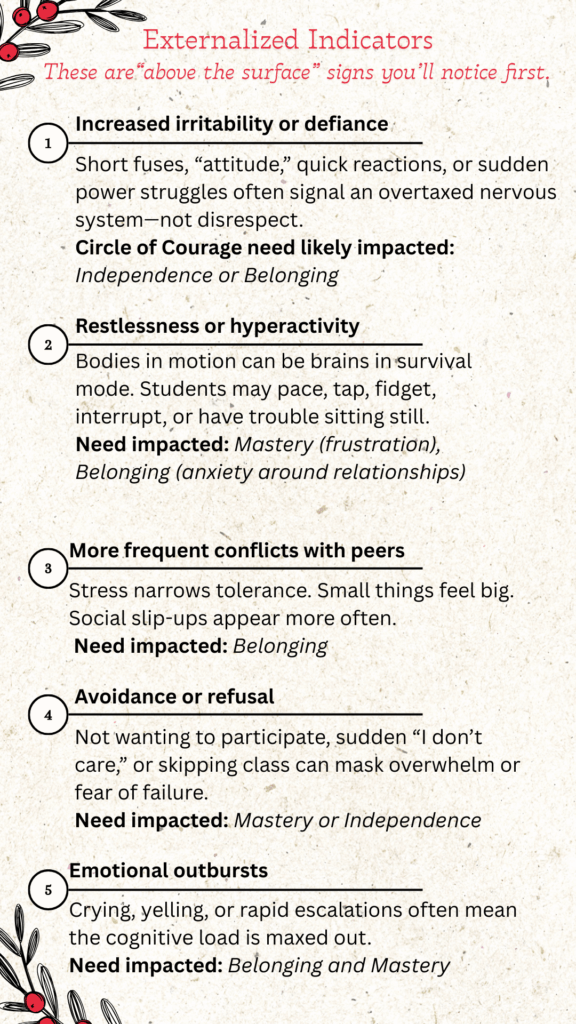
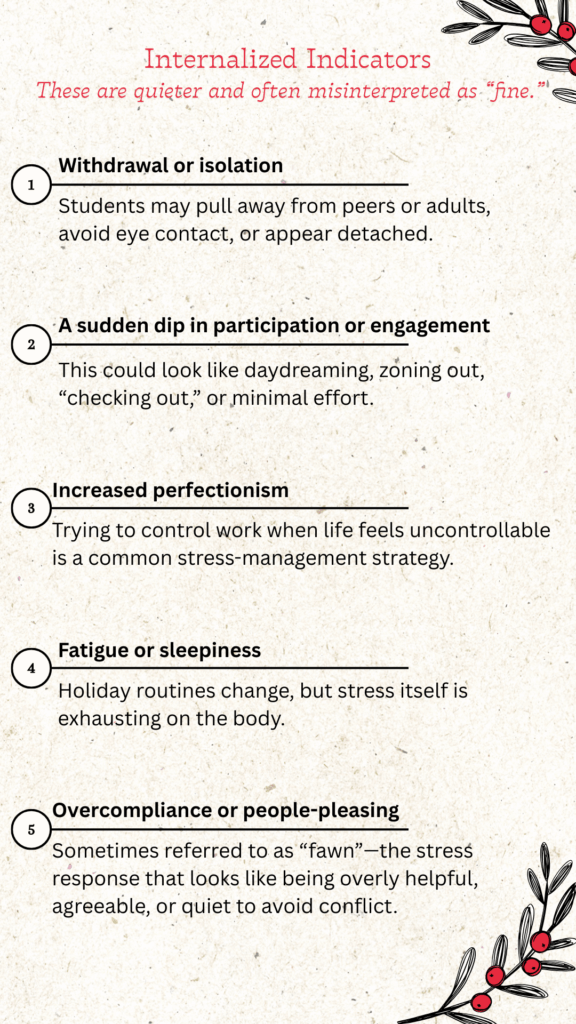
Internalized behaviors almost always signal needs around Belonging and Independence.
Trauma & Stress Science: Why Holidays Hit Hard
For many youth, holidays are tied to:
- Loss or grief
- Family conflict
- Economic stress
- Changes in caregiving arrangements
- Overstimulation (noise, events, schedules)
- Unpredictability
- Food or housing insecurity
- Memories of past holiday disappointments or harm
Even joyful excitement can heighten arousal in the nervous system.
Stress + excitement = dysregulation wrapped in glitter.
Knowing this helps us stay curious instead of reactive.
A Curiosity-First Approach: What You Can Do
Here’s the good news: spotting stress isn’t about labeling behavior.
It’s about naming underlying needs and responding with intentionality.
1. Lead with attunement.
A soft voice. A grounded presence. A quick, “I’m glad you’re here today.”
Regulation is contagious.
2. Offer predictability whenever possible.
Post agendas. Prep for schedule changes. Give advance notice.
Predictability lowers cortisol.
3. Use the Circle of Courage as a daily check-in.
Ask yourself:
Which need might this student be trying to meet?
How can I offer it without controlling or rescuing?
4. Normalize the season.
Say things like:
“This time of year can feel like a lot for people. If you ever need a moment, let me know.”
This reduces shame.
5. Build micro-moments of connection.
These take less than 60 seconds:
- Greeting at the door
- A genuine compliment
- A check-in on something personal
- Noticing effort (“I see how hard you’re trying today”)
Tiny investments. Huge returns.
6. Create opportunities for empowerment.
Choice boards. Leadership roles. Helpers. Options for how to complete work.
Independence quiets stress.
7. Allow regulation, not punishment.
A break corner, breathing tool, sensory movement, water break—these aren’t rewards; they’re regulation strategies.
8. Collaborate with caregivers when appropriate.
Sometimes a quick insight like, “Our holiday schedule is different this year” explains a lot.
9. Model self-regulation openly.
When adults narrate their strategies (“I’m going to take a deep breath before we dive in”), students learn the playbook.
10. Celebrate resilience openly.
Not the performance—the perseverance, the courage, the tiny steps forward.
A Final Word: Stress Behaviors Are Communication
Holiday stress isn’t a failure of character.
It’s a signal.
It’s a story.
It’s a need.
Every behavior—loud or quiet, messy or controlled—is a young person’s best attempt to navigate their world with the tools they have in that moment.
And every caring adult has the power to respond with compassion that says:
“I see you. I get it. You matter in this space.”
This season will always bring a mix of joy and challenge, but with curiosity, attunement, and the Circle of Courage guiding our lens, we can ensure that every student experiences something healing:
A steady adult.
A sense of belonging.
A moment of safety.
A glimmer of hope.
Because when students feel seen during the hardest seasons, their resilience doesn’t just rise—it shines.

