
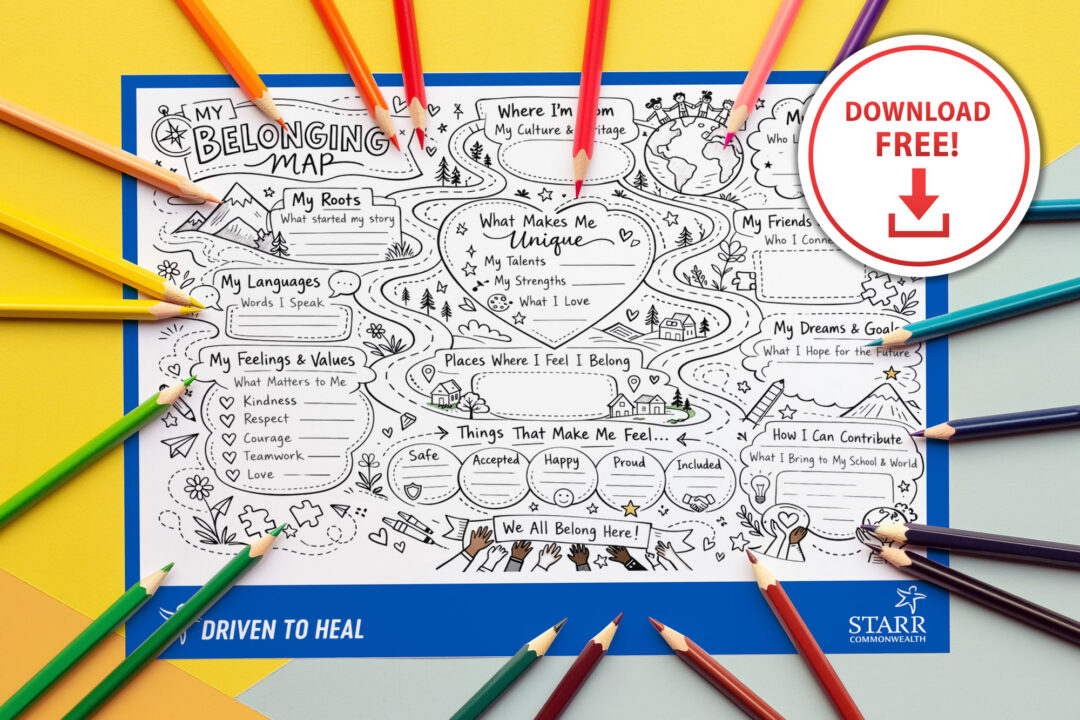
Last week, in The Heart of the Matter: Identity, we explored how identity shapes that sense of belonging. When young people feel seen, understood, and valued for who they are, they are better positioned to learn, connect, and grow.
If you’re familiar with the Circle of Courage, you know that Belonging isn’t just a “nice-to-have” first quadrant — it’s the biological and psychological prerequisite for everything else. Without a secure attachment to a community, a student’s brain cannot fully pivot toward Mastery, Independence, or Generosity. This week, we want to offer a practical tool to help turn that reflection into meaningful conversation.
The Belonging Map: A Gentle Invitation to Be Seen
Our free Belonging Map invites young people to slow down and explore the many layers of identity that make them who they are. Through simple prompts, youth are encouraged to reflect on:
- Where I’m From (My Culture & Heritage)
- My Roots (What started my story)
- My Languages (Words I speak)
- My Family (Who loves & supports me)
- My Friends & Community (Who I connect with)
- What Makes Me Unique (My talents, strengths, what I love)
- My Feelings & Values (What matters to me)
- Places Where I Feel I Belong
- My Dreams & Goals (What I hope for the future)
- How I Can Contribute (What I bring to my school & world)
At the heart of the map is a simple message: We All Belong Here.
When we create space for youth to name their roots, languages, strengths, values, and dreams, we send a powerful message: you matter here. This activity can open doors to conversations that might not surface in everyday interactions — the kind that build trust, mutual understanding, and shared humanity. Used with warmth and curiosity, it becomes more than a worksheet; it becomes a bridge — helping young people see themselves clearly and helping us see them more fully, too.
Bringing It Into Your Setting
The Belonging Map can be used in classrooms, counseling sessions, advisory periods, small groups, or professional learning settings. It might serve as a beginning-of-year community builder, a mid-year reflection tool, or a structured conversation starter when relationships need strengthening. When adults are willing to model their own reflections — sharing pieces of their story, values, or hopes — they communicate vulnerability and shared humanity. Over time, these small, intentional moments accumulate, reinforcing a culture where belonging is not assumed but actively nurtured.
Let’s commit this month to being the architects of a belonging so deep that every student can finally exhale and say, “I am home here.”

