
Reflections from a retired principal on how we turned ordinary school mornings into opportunities for connection, belonging, and resilience.
I spent more than 30 years in education. I was a teacher, a coach, an assistant principal, and eventually a principal for 16 years. And if there’s one thing I’ve learned, it’s that you can have the best programs, the best intentions, and some really great people working in your building, but if kids don’t feel connected to their school, you’re going to have a hard time reaching them.
I wish I could tell you I figured that out early in my career. I didn’t.
In fact, it wasn’t until the last few years before I retired that I really began to understand just how much the everyday experiences of our students mattered. Not just what happened during instruction. Not just what happened when a student got into trouble. I’m talking about the little things. The things we sometimes walk right past because we’re so busy trying to get through the school day.
Like what happens in the first 15 minutes after a kid walks through the door.
We Had to Start Looking at School Differently
Coming out of COVID, our school was struggling. We had kids who weren’t coming to school consistently. We had kids who were coming to school but struggling to stay in classrooms. We had staff who were exhausted, frustrated, and trying everything they knew to make things better.
And I was right there with them. We were working hard. But working harder at the same things wasn’t necessarily getting us anywhere.
As I began learning more about trauma-informed, resilience-focused education, I started thinking differently about what our students needed from us. I also had an opportunity to visit another school that was putting these ideas into practice.
I remember arriving before the students and just watching. Adults were outside meeting buses and greeting families. Kids came into the building, grabbed breakfast, and headed into classrooms that were calm and ready for them.
There wasn’t anything particularly complicated about it. But there was something different about the way the whole morning felt. It was intentional. And I remember thinking, Why aren’t we doing this?
We already had good people. We already had adults who cared about kids. We already had pieces of this happening throughout our building.
What we didn’t have was a shared approach that brought it all together. So, we decided to build one.
If We’re Going to Do It, We’re All Going to Do It
One thing my assistant principal and I agreed on was that this couldn’t become another thing we asked teachers to do while everybody else went about their morning. If we believed relationships mattered, then building those relationships had to be everybody’s responsibility.
And I mean everybody. Teachers. Administrators. Counselors. Social workers. Support staff. The people working in our hallways and helping with breakfast. Me included.
We assigned every adult in the building a place to be when students arrived. Some were outside meeting buses. Some were at the front entrance. Others were in the hallways, stairwells, or near classrooms.
The idea was that by the time a student reached their classroom, they had already been greeted by at least a couple of adults. Think about that for a second.
Before we asked a student to open a book, complete an assignment, or follow a direction, we had multiple opportunities to let them know we were glad they were there.
For some kids, that might not seem like a big deal. For others, it might be one of the most important parts of their day.
And here’s the thing: it didn’t cost us anything.
It took planning. It took consistency. It took everybody understanding why we were doing it. But it didn’t require another expensive program. It required us to be intentional with the people and time we already had.
Give Kids a Chance to Arrive Before Asking Them to Perform
Our students began entering the building at 8:15. They could grab breakfast, stop at their lockers, and head into their classrooms. Depending on when they arrived, they had anywhere from five to fifteen minutes before we began our community-building time at 8:30.
That was important to me.
Think about your own morning: Maybe you overslept. Maybe traffic was terrible. Maybe something happened at home, or you had an argument with somebody before leaving.
Now imagine walking into work and immediately being expected to perform at your best.
That’s what we sometimes ask kids to do. We don’t always know what happened before they got to us.
So why not give them a few minutes to settle in? Why not make sure the first thing they experience is a familiar face, a welcoming environment, and a little breathing room?
It sounds simple because it is. But simple doesn’t mean insignificant.
Every Morning, We Practiced the Pause
At 8:30, I would get on Google Meet with every classroom in the building. We had two adults assigned to each classroom, and we set things up so the students could see me and I could see them.
I loved that part of my morning. I’d greet the kids, acknowledge someone coming in a little late, and remind everybody that whatever kind of morning they’d had, they had an opportunity to begin again.
Then we’d practice what we called, The Pause.
We’d stop for a moment. Slow ourselves down. Take a breath. And we’d do it together.
Not because somebody was in trouble. Not because a student was having a difficult time. Because we wanted kids to practice that skill every single day.
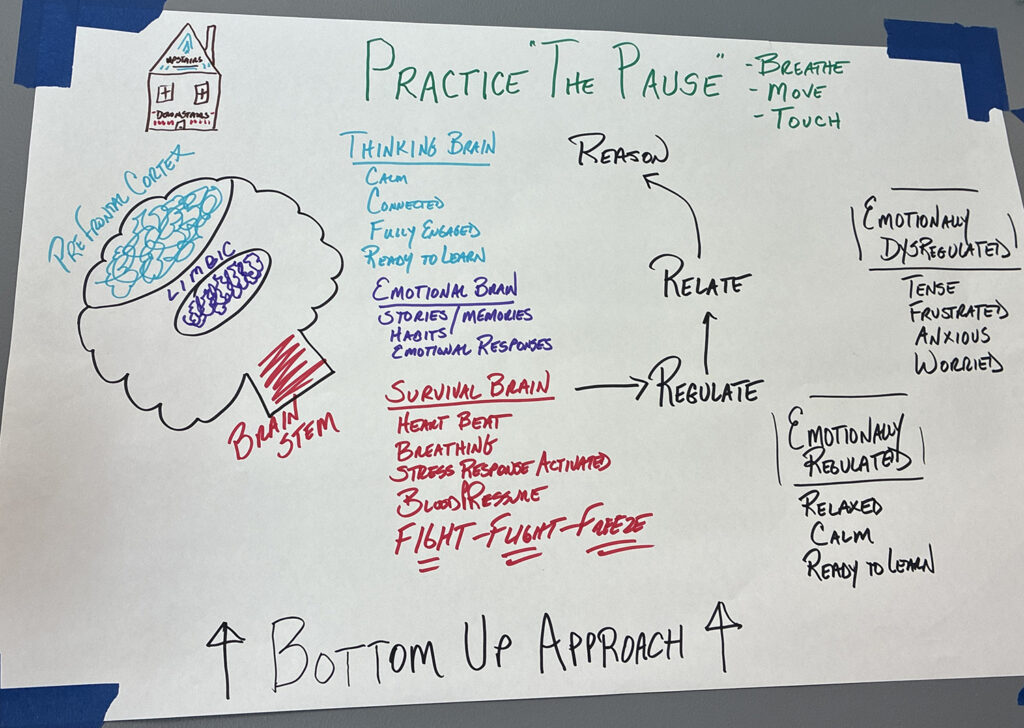
I used to remind them that we practiced the pause when things were going well so we’d know how to use it when things weren’t going so well.
That’s something I really came to believe in.
We can’t expect kids to suddenly know how to regulate themselves in the middle of a difficult moment if we’ve never given them opportunities to practice. And I didn’t want this to be something we only talked about. I wanted us to actually do it.
Every day. The Pause was just the beginning.
We Made Community Building Part of Our Schedule
We also built a weekly routine around community building and the four universal needs of the Circle of Courage: Belonging, Mastery, Independence, and Generosity.
On Mondays, we introduced a shared lesson from Starr Commonwealth’s Courageous Classroom curriculum.
One of the things I liked about this approach was that the entire building was focused on the same concept, just taught in ways that made sense for different grade levels.
That meant if we were working on a particular relationship skill, it wasn’t something students heard about once and forgot.
Teachers could reinforce it. Office staff could reinforce it. I could reinforce it. We were all speaking the same language.
On Tuesdays, our wellness team led a mindful moment and then students participated in community circles. Sometimes the mindful moment was just a short video.
I remember one of my favorites was a video of a goat lying in the grass, eating. That’s it. A goat. And for a couple of minutes, we were all just watching this goat do absolutely nothing.
I loved it.
Because sometimes that’s exactly what we need. A couple of minutes to stop doing and just be.
Then students would gather in circles and respond to prompts, ask questions, listen, and talk with one another. It might sound like a small thing, but think about all the skills kids are practicing in those conversations.
They’re learning how to listen. How to take turns. How to express themselves. How to be curious about somebody else’s experience. They’re building relationships.
On Wednesdays, we made time for mindful moments and for students to manage the recognition they’d earned through our positive behavior system.
On Thursdays, our instructional coaches led team-building activities.
That was another piece I really liked because we had new teachers and new instructional coaches. These activities helped them build relationships with students and one another while also introducing strategies teachers could use in their own classrooms.
It all worked together. And that was the point.
It Wasn’t About Adding More. It Was About Connecting What We Were Already Doing.
If you’ve been in education for any length of time, you know how this goes. Every year, there’s something new. A new initiative. A new curriculum. A new priority. And sometimes, before we’ve really had the chance to make one thing work, we’re moving on to the next.
My assistant principal and I were determined not to let that happen.
We wanted everything we did to connect back to what we were learning about trauma, resilience, and the universal needs of our students. That included our school improvement goals, our behavior recognition system, our morning routines, and the way we responded when students were struggling.
We weren’t trying to create a perfect school. We were trying to create a school where the things we said we believed were actually reflected in what students experienced.
That’s a big difference.
I often describe the shift from being trauma-informed to becoming trauma-responsive as the difference between knowing and doing.
You can know that relationships matter. You can know that students need belonging. You can know that practicing regulation skills helps students manage difficult moments.
But what are we actually doing with that knowledge? Where does it show up in the school day?
For us, it started showing up at 8:15 every morning.
You Don’t Have to Do It Exactly Like We Did
Now, I’m not suggesting every school needs to get its principal on Google Meet every morning or follow the exact schedule we created. We were a small fifth-through-eighth-grade building, and we figured out what worked for us. Your school might look completely different.
But I would encourage you to take a good look at the first fifteen minutes of your day. Walk through the building before students arrive. Watch what happens when they get there.
Who greets them?
What do they see when they enter their classrooms?
Do they have an opportunity to connect with somebody?
Do they have a moment to settle in?
And maybe most importantly, does every adult understand the role they play in helping students feel like they belong?
You might discover that you’re already doing a lot of really good things. Great. Build on them. Bring your people together. Talk about what’s working. Find opportunities to be more intentional and consistent.
Because one thing I learned throughout this journey is that meaningful change doesn’t always come from doing something bigger. Sometimes, it comes from doing the small things together, every single day.
I retired proud of what our school community had accomplished. Not because we had figured everything out, but because we had started to see what was possible when an entire staff committed to a shared purpose.
And if there’s one thing I hope other educators take from our experience, it’s this:
Don’t underestimate what can happen when every student walks into a building where the adults are genuinely glad they’re there.
Those first fifteen minutes matter.
And so do all the little moments that follow.
