
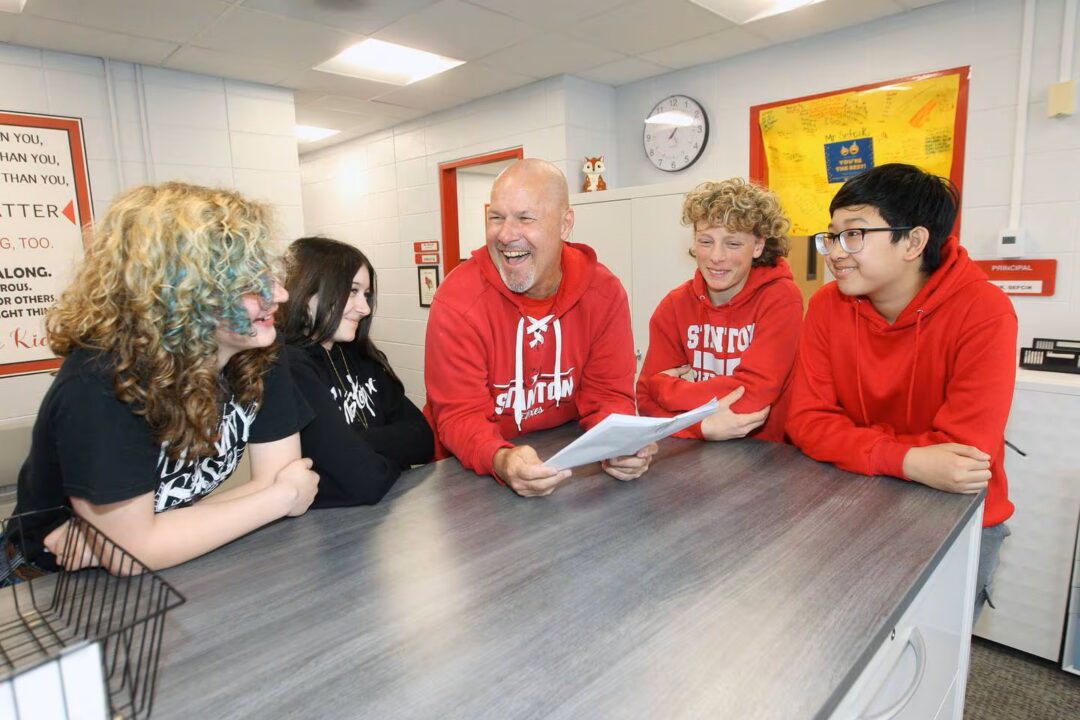
Reflections from a conversation with a retired principal on what it really takes to build a trauma-informed, resilience-focused school community.
Some of the most meaningful professional learning doesn’t happen in a training room or during a scheduled professional development day.
Sometimes, it happens in conversation.
Recently, I had the opportunity to sit down with Jeff, a recently retired principal who spent more than three decades in education. What began as a conversation about his school’s trauma-informed journey quickly became something much more meaningful: an honest reflection on leadership, the courage to try something new, the humility to recognize when something isn’t working, and the relationships that make lasting change possible.
As educators, I think we can all relate to pieces of his story.
We know the feeling of being inspired by something we’ve learned. We know the excitement of imagining what it could mean for our students. And we know that sometimes, despite our very best intentions, translating that excitement into sustainable practice is harder than we anticipated.
Jeff’s story reminds us that becoming trauma-informed and resilience-focused isn’t a destination we arrive at after completing a training or introducing a new initiative.
It’s a journey we take together.
It Started with a Question: What Else Can We Do?
Like so many schools across the country, Jeff’s fifth-through-eighth-grade building was navigating challenges that felt increasingly difficult to solve following the pandemic.
Attendance was a concern. Student behavior and classroom engagement were becoming more complex. And despite the dedication of his staff and student support team, the approaches they had relied on in the past weren’t creating the change they hoped to see.
What I appreciated about Jeff’s reflection was that he didn’t describe this as a lack of effort.
People were working hard. They cared deeply. They were trying.
But sometimes, even when we’re doing everything we know how to do, we find ourselves wondering whether there’s another way.
For Jeff, that curiosity opened the door to trauma-informed, resilience-focused education.
He began learning, asking questions, connecting with others, and exploring what it might look like to approach school culture through a deeper understanding of relationships, regulation, and students’ universal needs.
Eventually, he and members of his team visited another school where these practices were already part of everyday life.
They returned inspired.
And ready to get to work.
When Moving Fast Teaches Us to Slow Down
One of my favorite moments in our conversation was Jeff’s willingness to share a story about something that didn’t go quite as planned.
After visiting the school, he returned determined to make immediate changes in his fifth-grade classrooms, where students and staff were experiencing particular challenges.
Over a single weekend, he and two colleagues created regulation spaces, introduced sensory and movement tools, and developed visual supports inspired by what they had observed.
For the next several days, Jeff, his assistant principal, and his special education director each spent the first hour of the morning supporting one of the fifth-grade classrooms.
And for a little while, things were going really well.
Students were responding. The environment was shifting. There was excitement about what might be possible.
But eventually, those leaders needed to return to their other responsibilities.
And without that same level of support, the changes didn’t last.
Jeff reflected on how he’d expected his teachers to implement the practices with the same confidence and understanding he’d developed through his own learning.
His leadership team saw the potential in what they had started, but they also recognized something important.
They needed time to learn together before they could lead together.
So they slowed down.
I think there’s something incredibly valuable in that moment, particularly for those of us who lead others.
Sometimes, our enthusiasm for change can move faster than the relationships, understanding, and shared ownership needed to sustain it.
And sometimes, the most impactful thing we can do as leaders is listen when our teams remind us of that.
Finding the People Who Help a Vision Grow
Jeff spoke often about his guiding coalition, the group of educators and school leaders who helped transform his initial vision into something the entire school community could embrace.
He described the importance of finding those first followers: the people who see the possibility in an idea and are willing to help bring it to life.
That summer, his leadership team completed trauma-informed training together.
They paused lessons to talk. They revisited ideas. They highlighted passages, asked questions, and considered how the concepts could fit into the realities of their school.
Some were learning the material for the first time. Others were experiencing it again with fresh eyes.
And somewhere in that process, the work began to shift.
It was no longer one principal’s vision for what his school could become.
It was becoming their vision.
This part of Jeff’s story made me think about the many ways we invite staff into school improvement.
Are we asking our teams to carry out a plan we’ve already created? Or are we creating meaningful opportunities for them to help shape the direction?
Are we allowing room for questions, different perspectives, and honest feedback?
And perhaps most importantly, are we remembering that the adults in our buildings need the same sense of belonging, voice, and connection that we’re working so intentionally to create for students?
Not Another Thing. A Different Way of Doing Things.
If you’ve worked in education long enough, you’ve likely experienced the familiar cycle of initiatives.
We introduce something new, invest time and energy into learning it, and just as it begins to feel familiar, another priority takes its place.
Jeff and his assistant principal were intentional about avoiding that cycle.
Rather than treating trauma-informed practices as another program to implement, they began using the Circle of Courage and its four universal needs—Belonging, Mastery, Independence, and Generosity—as a foundation for the work they were already doing.
School improvement goals reflected those needs.
Their existing positive behavior recognition system was reimagined to reinforce them.
Social-emotional learning became a shared schoolwide experience, with students across grade levels exploring common themes in developmentally appropriate ways.
Even the way students entered the building each morning became an opportunity to put those beliefs into practice.
Every adult had a role in welcoming students. Familiar faces greeted them at entrances, in hallways, and near classrooms. Students were given time to settle into their mornings before instruction began.
Throughout the week, community-building experiences, mindful moments, shared lessons, and team-building activities reinforced the same principles.
And this wasn’t limited to teachers or student support staff.
Bus drivers, cafeteria staff, administrators, and other adults throughout the building were included in the learning.
What struck me most was that many of these practices weren’t necessarily new.
Educators have been greeting students, building relationships, and creating opportunities for connection for years.
But Jeff’s school was doing something especially intentional.
They were connecting those individual efforts through a shared understanding of why they mattered.
Jeff described the difference between being trauma-informed and becoming trauma-responsive in just four words:
“Knowing and then doing.”
Simple, isn’t it?
And yet, that may be one of the most important distinctions in this work.
The Culture We Create for Adults Matters, Too
Another part of our conversation has stayed with me.
Jeff described an administrative retreat where his leadership team stepped away from the school building to spend dedicated time reflecting, collaborating, and developing their school improvement priorities.
It was an opportunity to do important work, but also to connect as people.
And I found myself thinking about how often we discuss creating safe, connected, supportive environments for students without always considering whether we’re creating those same experiences for the adults who care for them.
What might happen if we approached our staff meetings, leadership retreats, and professional learning experiences with the same intentionality we bring to our classrooms?
What if our teams had more opportunities to experience belonging, exercise their voice, contribute their strengths, and feel genuinely connected to a shared purpose?
The Circle of Courage isn’t just a framework for understanding what students need.
It’s a reminder of what all of us need.
And when school leaders create environments where adults feel supported, trusted, and valued, we’re doing more than improving staff culture.
We’re modeling the very practices we hope will become part of everyday life for our students.
The Work Is Never Really Finished
Toward the end of our conversation, Jeff shared that his school’s journey had produced encouraging improvements in attendance, behavior, and school culture.
But what stood out to me wasn’t a particular outcome or statistic.
It was the way he talked about the process.
The lessons learned. The relationships built. The things he would do differently. The people who helped make the work possible.
Even in retirement, Jeff continues sharing his experiences with other educators and school leaders, hoping something from his journey might help someone else take their next step.
And maybe that’s what makes this work so meaningful.
We don’t have to have every answer before we begin. We don’t have to implement every strategy perfectly. And we certainly don’t have to navigate the journey alone.
We can remain curious. We can invite others alongside us. We can celebrate what’s working, learn from what isn’t, and keep growing together.
A Few Questions to Carry Into Your Own Leadership Journey
As we continue working toward more trauma-informed, resilience-focused school communities, I invite you to reflect on a few questions inspired by Jeff’s experience:
- Who are your first followers? Who helps bring your vision to life, challenges your thinking, and shares ownership of the work?
- Where might slowing down help you move forward? Are there opportunities to deepen shared understanding before introducing something new?
- What are you already doing well? How might existing routines, relationships, and school improvement efforts become more intentionally connected to the universal needs of your students and staff?
- Are your adults experiencing what you’re hoping to create for your students? How are belonging, mastery, independence, and generosity reflected in the way you lead?
Perhaps the most meaningful takeaway from my conversation with Jeff is that becoming trauma-informed and resilience-focused isn’t about doing more.
It’s about becoming more intentional with what we do, how we do it, and the people we do it alongside.
Because the journey from knowing to doing doesn’t happen all at once.
It happens in the conversations we have, the relationships we nurture, the decisions we make, and the willingness to keep learning together.
And that’s a journey worth continuing…
Continue Your Journey with Starr Commonwealth
Whether you’re just beginning to explore trauma-informed education or looking for meaningful ways to bring what you’ve learned into everyday practice, Starr Commonwealth offers training and resources to support you along the way.
Explore our Certified Trauma and Resilience Specialist training and discover how a shared understanding of trauma and resilience can help shape stronger, more connected school communities.

